Recruitment, at its best, is a relationship job. The value a good recruiter brings is their ability to read people: assessing culture fit beyond a CV, spotting potential that doesn’t show up in a job title, building the trust that gets a passive candidate to take a more active call. This is the work that moves the needle and keeps businesses staffed with the best people for the job.
It is also, for most recruiters, a fraction of how they actually spend their time.
The hours that disappear before the real work starts
The most time-consuming step in the recruitment process is sourcing passive candidates. According to Entelo, recruiters spend an average of 13 hours a week, per role, searching for candidates. That is nearly a third of a full working week spent on what is essentially structured internet searching.
Then comes screening. At 30 to 90 seconds per CV during initial screening, a recruiter working through 200 applications for a single role is spending 5 to 15 hours on pure triage before any meaningful candidate interaction occurs. Scaled across multiple open positions running simultaneously, screening alone can consume entire days.
After screening comes scheduling. 67% of recruiters say it takes between 30 minutes and 2 hours to schedule a single interview, according to HootRecruit’s Recruiter Time Audit. The back-and-forth between candidates, hiring managers, and panel members creates coordination overhead that compounds across every open role.
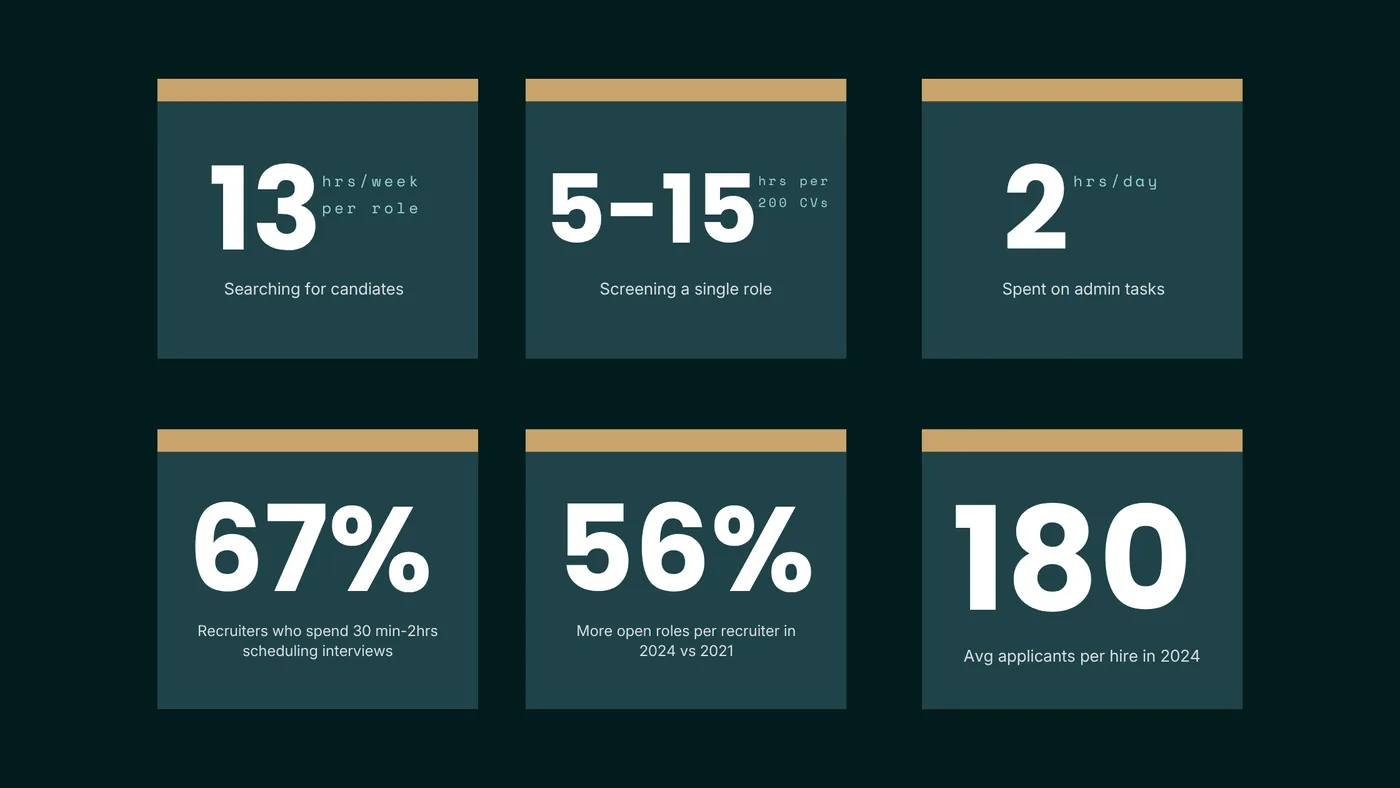
In-house recruiters spend almost two hours a day on administrative tasks, equivalent to more than an entire work day each week, according to research cited by IQTalent.
None of that time is wasted on unimportant things. Sourcing, screening, and coordination are necessary. But none of it is where recruiter judgment is actually irreplaceable.
The volume problem
The volume of applications has increased significantly and is not coming down. In 2024, employers received an average of 180 applicants per hire, according to CareerPlug’s 2025 Recruiting Metrics Report, which analysed over 10 million job applications. For competitive roles at well-known organisations, the numbers are far higher, with some corporate postings regularly attracting 250 to 500 or more applications.
81% of recruiters spend less than a minute on a CV during initial screening. And while it is easy to read that as a failure of diligence, the reality is that it is the only rational response to a volume like this. When the inbox contains hundreds of applications and multiple roles are running in parallel, a recruiter who spends five minutes on every CV is a recruiter who never gets to the shortlist.
Picture the end of a Tuesday. A recruiter has worked through 80 CVs since morning. The next 40 still need reviewing before the hiring manager debrief at 4pm. The candidates in that final batch are getting less attention than the ones reviewed at 9am. Not because the recruiter is careless, but because that is what happens to human attention under sustained load.
Research on decision-making confirms this pattern: evaluation quality declines as volume increases, standards drift as similar profiles accumulate, and unconscious bias becomes more pronounced under time pressure and cognitive load. Good candidates get missed because this system is not built for the volume it now receives, or for the very human limitations of even the most diligent recruiter.
The job description problem
Before any of the above, there is the job description itself.
Writing a job description that attracts the right candidates and not just a high volume of applications requires genuine skill. It needs to be accurate about the role, clear about requirements, positioned correctly for the talent market, and aligned with how candidates actually search. In practice, too many job descriptions are written quickly, recycled from previous postings, or drafted by someone who is not close enough to the role to describe it well.
A poorly written job description does not just produce a weak applicant pool. It produces the wrong applicant pool, which means more screening time, lower shortlist quality, and a longer time to fill. Which compounds every downstream step.
The scaling problem
All of this becomes significantly harder as organisations grow. A recruiter dealing with three open roles has a manageable, if demanding, workflow. The same person who has to juggle fifteen roles is triaging constantly, never going deep, and making decisions on less information than they would like.
According to Gem’s 2025 Recruiting Benchmarks Report, the average recruiter now manages 56% more open requisitions and handles 2.7 times as many applications as three years ago. Team sizes, meanwhile, have been shrinking: average recruiter headcount per team fell from 31 in 2022 to 24 in 2024.
Scaling recruitment without scaling the team means recruiting at speed with reduced quality, while scaling the team is expensive and slow. Most organisations end up somewhere in between, hiring at a pace that feels fast but produces results that feel unreliable.
What the data says about where AI fits
99% of hiring managers now use AI in some part of the recruitment process, and 98% say it has meaningfully improved their hiring efficiency, according to Insight Global’s 2025 AI in Hiring survey. Workable’s research found that 86% of recruiters say AI makes the hiring process faster, with screening identified as the area of greatest advantage.
The pattern in the data is consistent: AI performs well on the high-volume, repetitive, criteria-based parts of recruitment. It does not replicate what a recruiter brings to a final decision. The strongest implementations are not the ones that remove the recruiter from the loop. They are the ones that return the recruiter to the work that actually requires them.
What comes next
The problems described above are structural. They are not solved by working longer hours or optimising the spreadsheet. They are solved by changing what the recruiter is asked to do in the first place. By removing the volume work from their desk so the judgment work gets the attention it deserves.
That is the problem Zirora’s Sourcing Agent is built to address. More on that soon.
Zirora builds AI agents for recruitment, hospitality, and real estate that connect to live systems and take action.
Get in touchSources
- Entelo (cited via Greenhouse Partner Directory and industry blogs): recruiters spend an average of 13 hours a week sourcing candidates for a single role.
- Yello, 2020 Interview Scheduling Statistics and Trends (republished by HootRecruit): 67% of recruiters say scheduling a single interview takes 30 minutes to 2 hours.
- Stratus HR / general industry benchmarking: 30 to 90 seconds per resume during initial screening.
- Cornerstone OnDemand study (53 in-house recruiters), cited by IQTalent: in-house recruiters spend almost two hours a day on administrative tasks.
- CareerPlug, 2025 Recruiting Metrics Report (10M+ applications, 60,000+ small businesses analysed): an average of 180 applicants per hire in 2024.
- Standout-CV / ResumeGo 2024 recruiter survey: 81% of recruiters spend less than a minute on a CV during initial screening.
- Gem, 2025 Recruiting Benchmarks Report (140M+ applications, 1.3M hires analysed): the average recruiter manages 56% more open requisitions and 2.7x more applications than three years ago; team headcount fell from 31 (2022) to 24 (2024).
- Insight Global, 2025 AI in Hiring Survey Report (1,005 hiring managers): 99% use AI in some capacity; 98% report significant efficiency improvements.
- Workable, AI in Hiring survey: 86% of recruiters say AI makes the hiring process faster, with screening cited as the area of greatest advantage.